
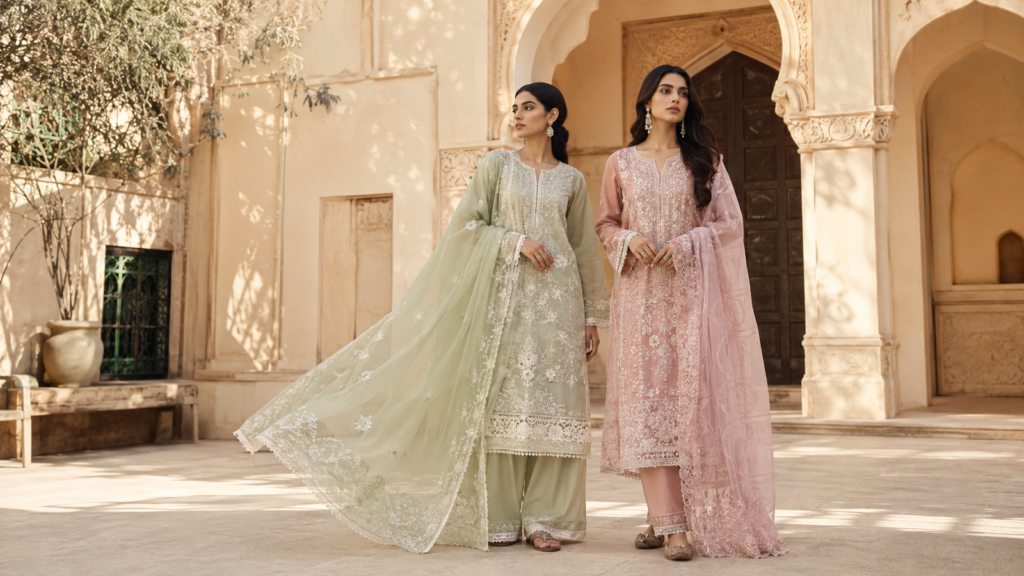
An underused suit collection may contain plenty of attractive pieces but too few combinations you can put on without thought. The missing item is often easier to identify by testing pairings than by counting clothes.
Choose five shirts you would like to wear more often. Place them where you can compare them with your existing trousers, dupattas and layers. Work with actual garments rather than colour names in a shopping list.
Give every shirt a complete outfit
For each shirt, assemble the combination you would wear tomorrow. Include the underlayer, shoes and dupatta if they are part of your routine. If you stop halfway, write down what is preventing completion.
Your notes may reveal different problems: no suitable trousers, a dupatta that needs attention, an uncomfortable slip or a hem that does not work with the shoes you use. Only some of those problems require another purchase.
Build a small pairing grid
Put shirt names down the side and existing bottoms across the top. Mark a pairing only after trying or laying the pieces together. Add a note for proportion and comfort, not just colour.
For example, “navy kurta with cream straight trousers: works for visits” is useful. “Cream goes with everything” is too broad to guide a purchase. A short tunic and a long kameez may need different trouser shapes even when both share a colour.
Look for the repeated missing component
Suppose three shirts would work with a plain, comfortable bottom, while a fourth needs a specific festive dupatta. The plain bottom may unlock more of your ordinary week. The festive dupatta may still deserve priority if a relevant event is approaching.
Choose according to your calendar rather than automatically buying the item that appears most often in the grid. Frequency and urgency are separate reasons to prioritise a gap.
- Name the incomplete outfits.
- Identify the exact missing component for each.
- Test a borrowed or existing alternative where practical.
- Rank unresolved gaps by actual planned use.
Keep the purchase specification narrow
If trousers are the answer, record the waist construction, rise, length and shape you prefer. If a dupatta is missing, note dimensions, colour relationship and border detail. Take reference photographs for your own comparison, while remembering that screens may alter colour appearance.
Avoid buying another complete suit solely to acquire its bottom or dupatta unless you also want the remaining pieces. Compare the cost and use of the whole purchase honestly.
Update the grid after the new piece arrives
Try the intended combinations before declaring the gap solved. Record any fit or finishing concern while the item remains unchanged, and follow the seller’s applicable process if needed.
Once the new separate works, photograph the complete outfits. That turns a successful purchase into combinations you can repeat, rather than another piece whose purpose is forgotten.
For the next step, read planning a trouser rotation and organising dupattas by complete outfits.
Use the women’s essentials collection to investigate a specific missing component identified by your pairing grid.
Continue exploring Wardrobe Planning or browse the Feyorawears Style Journal.
Featured image: Feyorawears editorial illustration.