
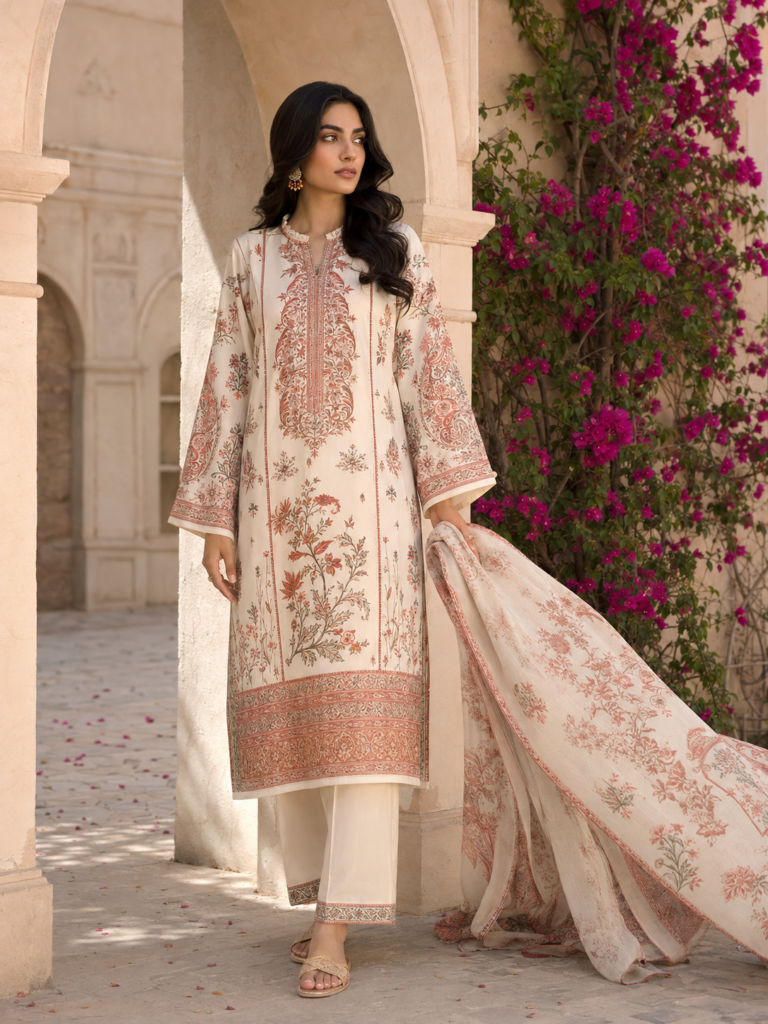
When a womenswear listing uses the word slub, ask what visible texture the seller is describing on that actual piece. A close-up may help you understand the appearance, but it should not be asked to prove the fibre content, origin or durability. Treat the image as one part of the product information and request the separate specifications needed for the purchase you are considering.
Ask for a view with context
A very tight crop can make a small surface feature look dominant. Request a close-up and a wider photograph of the same area so you can understand its scale. Include an ordinary outfit view in the comparison if the material is already made into a garment.
You want to know how the texture reads across the shirt or dupatta, not only whether the camera can reveal it. If the wider image shows a different colour or surface impression, ask whether lighting or a different variant explains the change.
Separate an intended feature from an unresolved detail
If you notice a line, irregular area or change in appearance, ask whether it is part of the design. Do not assume every visible variation is a fault, and do not accept a fabric term as the answer to every concern. A specific photograph and a precise question give the seller something useful to address.
For example, you might circle an area in your own reference copy and ask whether that feature appears throughout the cloth or only in the photographed section. Keep the response with the item reference rather than generalising it to other products.
View the texture beside the planned decoration
Place the candidate image beside the neckline, border or print you intend to use. Decide whether the texture supports those details or competes with them. If the surface is the feature you like most, a simpler decoration plan may make it easier to see.
For an unstitched purchase, ask your tailor to assess the actual cloth and layout before promising a particular finished effect. A close-up gives useful visual information, but it is not a cutting plan or a substitute for assessing the supplied pieces.
Keep the specification questions separate
- Which fibres and percentages are documented?
- What dimensions or quantities are supplied?
- Does the photograph show the exact selected variant?
- What preparation and care information accompanies it?
- Can the seller clarify the particular visible detail you queried?
Use the fabric video request guide if a still image leaves the overall appearance unclear. If the item is described as karandi, the karandi buying notes connect texture questions with cut and coverage.
Explore unstitched sets with a clear distinction between what you can see and what you still need documented. That approach makes close-ups useful without turning them into a test they cannot perform.
Continue exploring Dhanak & Winter Fabrics or browse the Feyorawears Style Journal.
Featured image: Feyorawears editorial illustration.