
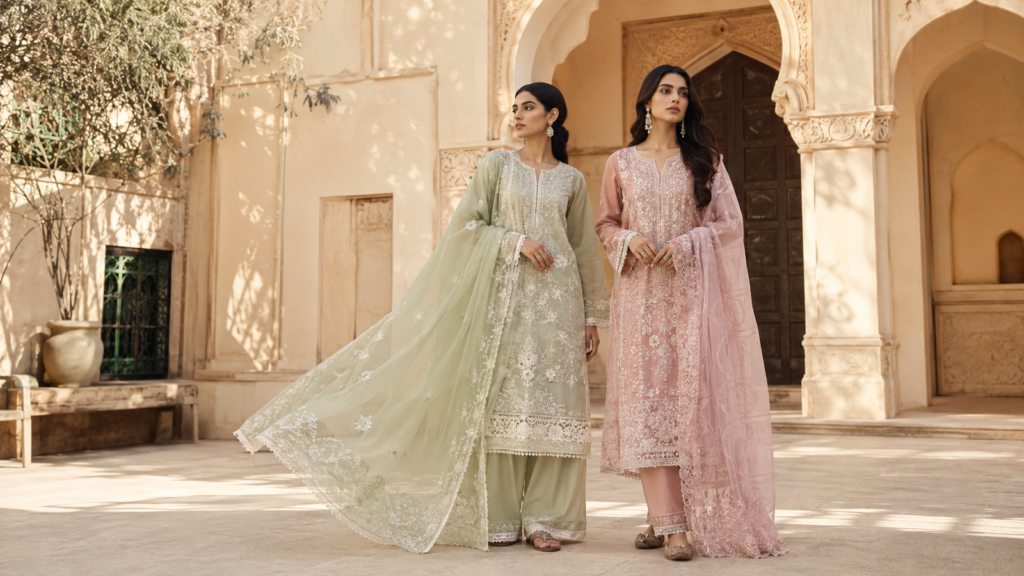
A week of celebrations needs more coordination than a short visit, especially when outfits share trousers, dupattas or accessories. The most useful packing list connects each event to a complete combination and shows when a shared piece will be needed again.
Begin with the confirmed schedule. Keep possible dinners or visits in a separate line so flexibility does not turn into several unnecessary complete outfits.
Build an event grid
Write the day, setting, expected movement and planned outfit for each occasion. Add travel days, homewear and sleepwear. If you will change between an afternoon gathering and an evening event, give each its own row.
Check what facilities and storage space will actually be available where you stay. Do not plan around an iron, cleaner or wardrobe that you have not confirmed and may not be suitable for your clothes.
Track shared components explicitly
Use the same name each time a trouser, dupatta or pair of shoes appears. Then read down the week to spot conflicts. A component needed for two consecutive events may require a care or inspection interval that your plan has overlooked.
Sharing pieces can simplify the bag, but only when you are comfortable repeating them and the combinations have been tested. Do not count theoretical matches that you have never tried together.
Work through a five-event example
Suppose the week includes a casual lunch, mehendi, wedding, family dinner and farewell visit. You plan three main outfits, repeating one with a different dupatta for the dinner and using a familiar day suit for both casual visits.
Now trace the components. If the same dress shoes serve the wedding and dinner, keep them accessible after the wedding. If the dinner outfit depends on a dupatta that needs attention after the earlier event, assign another suitable piece or a realistic care plan.
The grid reveals these dependencies before they become a late-night search through luggage.
Pack by access as well as outfit
- Place the first change where you can reach it on arrival.
- Keep nightwear available without unpacking every occasion outfit.
- Label accessory pouches by the outfits they complete.
- Keep shoes and toiletries separate from clothing.
- Include an accessible space for items needing care after use.
Choose handling and storage from the actual garment instructions and construction. Heavy decoration or delicate pieces may need an individual approach; one folding or rolling method should not be assumed suitable for everything.
Add two review points
Before leaving, point to every component in each event row. Midway through the visit, review what remains ready for the next occasions. A small adjustment at that point can prevent a shared item from being overlooked.
Keep a photograph of each complete combination and the relevant care notes on your phone. The objective is to arrive with usable outfits and enough clarity to enjoy the week, not to achieve the smallest suitcase at any cost.
For the next step, read reusing pieces across wedding events and checking occasion clothes after travel.
Fill only a confirmed event gap from the luxury pret collection, using the current item and delivery information.
Continue exploring Wardrobe Planning or browse the Feyorawears Style Journal.
Featured image: Feyorawears editorial illustration.