
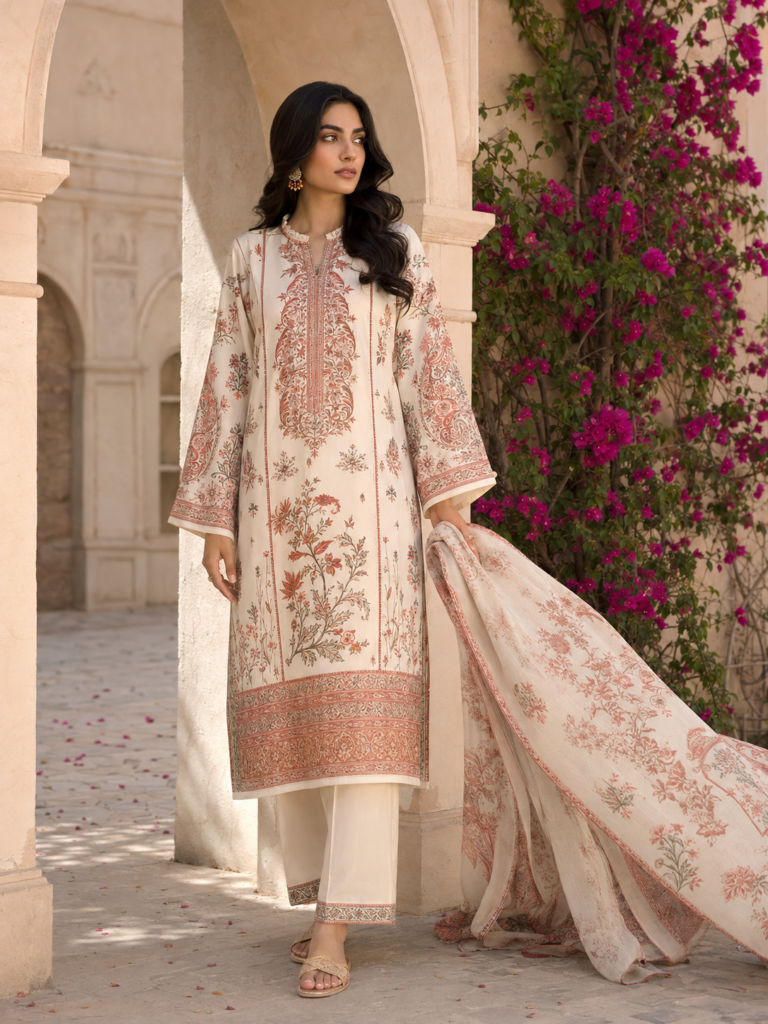
A winter suit may be sold as one outfit while containing several different materials. Reading only the main composition line can leave you uncertain about the shawl, lining or decorative components. Make a small record for each piece instead. This gives you clearer information for shopping, tailoring and later care, without asking a single fabric name to describe everything inside the package.
Start with a component map
List the shirt, trousers and dupatta or shawl, then add any separate lining or supplied trim. Use the seller’s exact descriptions in the first column. In the next, record the documented fibre information. A third column can hold dimensions or quantities so the information remains attached to the correct piece.
Do not copy one percentage breakdown across the whole set unless the seller explicitly confirms that it applies. A colour-coordinated outfit can still have distinct component descriptions, and the page may present those details in different sections.
Give specific details priority over shortcuts
Khaadi’s KD08BST-VG_MULTI listing illustrates the issue: its component details identify a cotton khaddar shirt and trousers, alongside a shawl listed as 60% viscose and 40% cotton. The example shows why a shopper should read the separate fields rather than extend the general composition line to every piece.
If fields appear inconsistent, ask for clarification. Do not decide privately which version must be correct and then treat that interpretation as verified. Save the reply with the product reference and selected variant.
Work through a sample record
Imagine an unstitched package with a named shirt fabric, matching trouser cloth and a separately named shawl. The shirt entry contains a fibre percentage, but the shawl entry does not. Your map should show the shirt’s confirmed information and the shawl’s unresolved composition.
That record is useful even before every gap is filled. It prevents a later conversation with a tailor or cleaner from beginning with the inaccurate statement that the whole outfit is made from one material.
Keep care information attached to the right piece
Photograph labels and any supplied instructions when the set arrives. Identify which item each belongs to, especially when the pieces are similar in colour. Where instructions are incomplete, seek advice for the specific component rather than applying another piece’s routine by default.
Our embroidered garment care guide explains how to prepare a focused enquiry. For named linen blends, the composition comparison guide helps distinguish an identified mixture from an incomplete description.
Keep detached tags in an envelope marked with the component name so their information is not separated from the outfit.
Browse unstitched clothing with a component map rather than one material box to tick. The result is a more accurate understanding of the outfit you are choosing and a record you can continue using after the purchase.
Continue exploring Dhanak & Winter Fabrics or browse the Feyorawears Style Journal.
Featured image: Feyorawears editorial illustration.