
Dhanak can appear prominently in a clothing title, but a prominent word is not a complete material specification. Before comparing suits, establish how the seller is using the term in that particular listing. Is it the design’s name, the cloth description or part of a collection title? Reading the surrounding fields carefully is more useful than assuming every product containing the word must have the same composition.
Check where the word appears
Look at the title, the material section and the component list separately. In its official collection, Bonanza Satrangi lists Dhanak as a named three-piece design, identified by SKU WU3PSLS26NA1F2. The collection title alone does not establish that item’s fibre recipe. This is an example of why the position of a term matters when reading a page.
If another seller writes Dhanak under fabric, record that as the seller’s cloth description. Then look for composition information, rather than treating the description itself as a percentage breakdown. An unanswered question should remain unanswered in your notes.
Ask about the exact item
Send the product reference and specify the colour or variant you mean. Ask which fibres and percentages are documented for the shirt, trousers and shawl or dupatta. If the seller supplies a label image, confirm which component it belongs to.
You can also request finished dimensions, fabric lengths for an unstitched purchase, and the applicable care instructions. These details make the enquiry useful even when the supplier cannot explain the trade name fully. Avoid replacing missing information with claims about warmth or durability.
Use a fact-and-preference note
Imagine a suit whose listing says printed Dhanak, includes a shirt and trousers, and gives no composition. Your factual notes contain those stated contents and the unresolved material question. Your preference notes might say that you like the print’s spacing and the proposed shirt length.
Keeping the two columns separate allows you to appreciate the design without implying that its material properties have been verified. It also makes it easier to compare an alternative that provides more detailed specifications.
Decide what must be answered before buying
- Which component does the fabric description refer to?
- Is a fibre breakdown or supplier specification available?
- What exactly is included in the purchase?
- What preparation or tailoring is still needed?
- Which care information accompanies the actual item?
Use the component-by-component composition guide when a set contains several materials. If the alternative is khaddar, the Dhanak-versus-khaddar comparison provides a way to organise the decision without declaring a universal winner.
When a reply refers to another colourway, ask whether the specification also applies to your selected variant before recording it.
Browse unstitched clothing with those questions ready. Understanding a listing means knowing both what it tells you and what it leaves open, rather than giving a familiar fabric name more certainty than the evidence supports.
Continue exploring Dhanak & Winter Fabrics or browse the Feyorawears Style Journal.
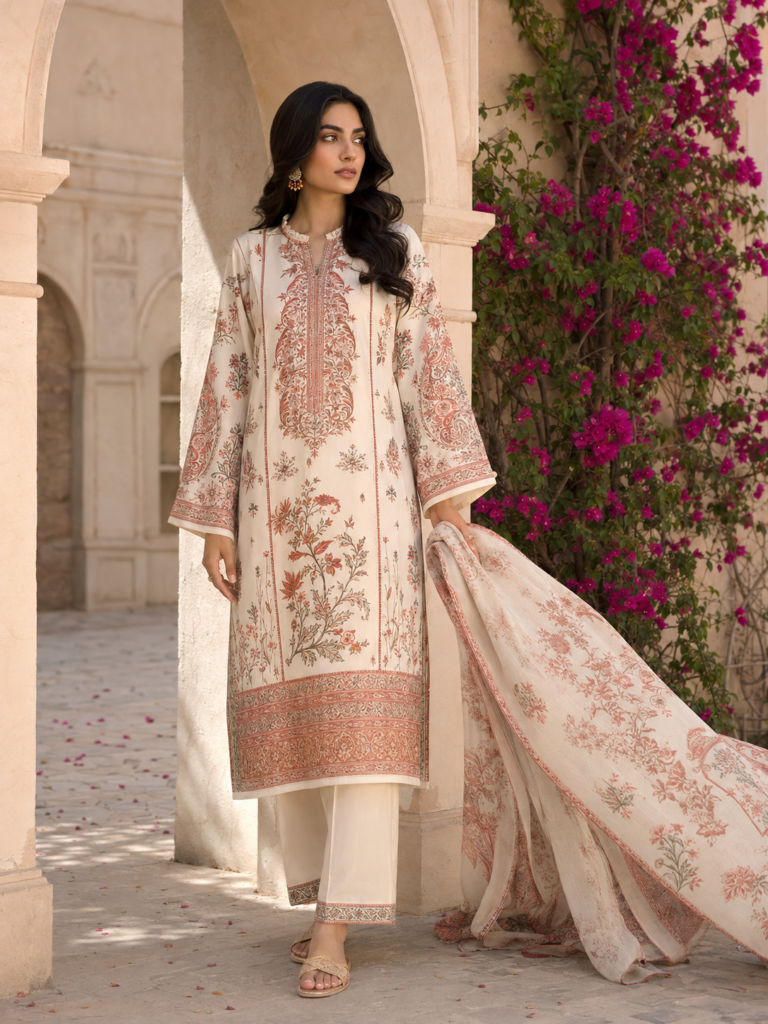
Featured image: Feyorawears editorial illustration.