
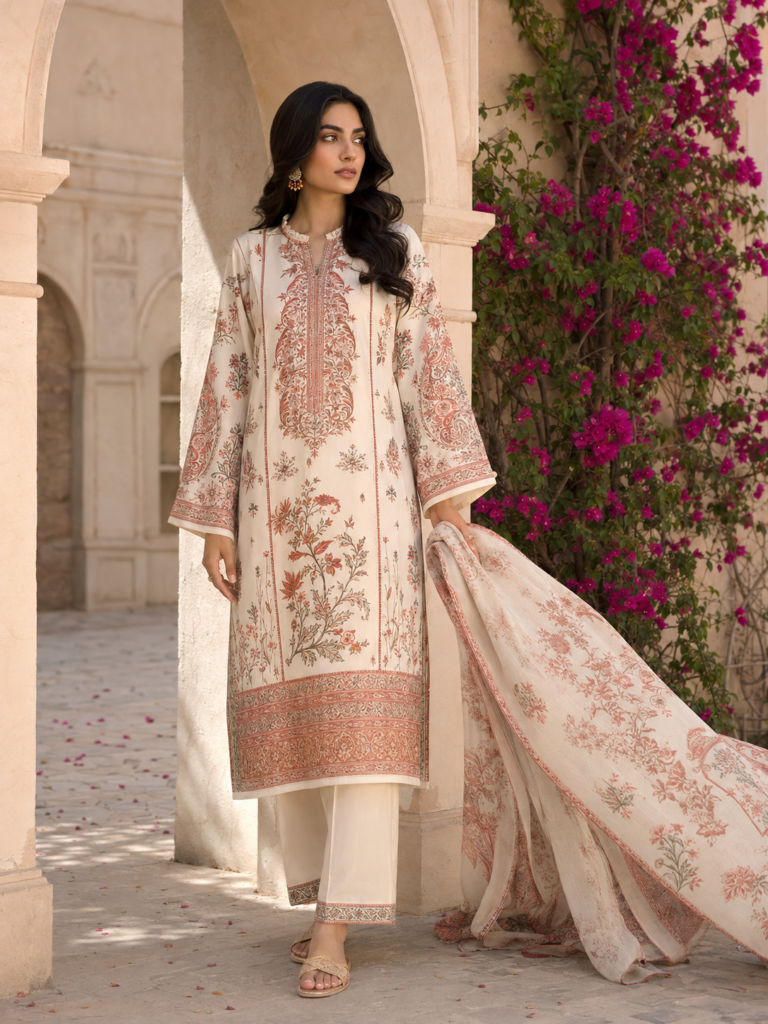
A suit can have a striking neckline and still leave you uncertain about its finishing. Instead of judging the whole outfit from its most decorative photograph, give each area a separate look. The aim is to identify details you can actually observe and questions that still need an answer.
Think of this as a viewing sequence, not a grading system. A close-up can reveal a folded edge or a loose end, but it cannot prove long-term durability, fibre content or the history of the garment.
Begin with the outline
View the shirt hanging naturally, without a pose that hides one side. Look at the neckline, shoulders, hem and side openings. Decide whether the shape appears consistent with the stated design. An intentionally asymmetric hem should be assessed against that design, rather than treated as an error because its two sides differ.
Then look at the trousers and dupatta individually. A beautifully presented shirt should not distract from a trouser waistband you cannot see or an unfinished-looking corner that needs clarification.
Move from decorative areas to working areas
Request views of the inside neckline, underarm seam, trouser crotch seam and waistband. These photographs answer different questions from a front portrait. Ask the seller to show the garment without pulling the seams apart or placing it under strain.
- Check whether edges appear secured or leave unexplained loose material.
- Look for seams that sit as intended rather than visibly gathering in one isolated place.
- Check whether a lining lies smoothly and covers the area described.
- Inspect the reverse of a decorative border as well as its face.
- Ask about any loose fastening before deciding whether the item is acceptable.
These observations should produce specific questions. “Is that thread attached to the embroidery?” is more useful than declaring a garment poor quality from one compressed photograph.
Use a three-column note
Suppose you are considering a plum occasion suit. In the first column write “neckline finish,” “sleeve edge” and “trouser closure.” In the second, record what the photographs show. In the third, write what remains unknown.
Your note might say: neckline interior visible and neat; sleeve border underside not shown; zip operation not demonstrated. You now need two targeted checks, rather than another set of distant styled photographs.
Do not fill unknown cells with optimistic assumptions. If a detail matters to comfort or the work needed before wearing, resolve it before including the outfit in your shortlist.
Decide what you can accept
A minor repair you understand may be a different proposition from an unexplained construction problem. Ask what work is needed, who will do it and whether the seller is offering the item in its present condition. Keep that answer with the order details.
Choose according to the whole garment and your intended use. Elaborate decoration, a high price or a designer reference does not replace evidence about the actual item you will receive.
For the next step, read a closer seam inspection and checking buttons, loops and zips.
Browse the ready-to-wear collection with your own finishing checklist beside the product details.
Continue exploring Quality & Buying or browse the Feyorawears Style Journal.
Featured image: Feyorawears editorial illustration.