
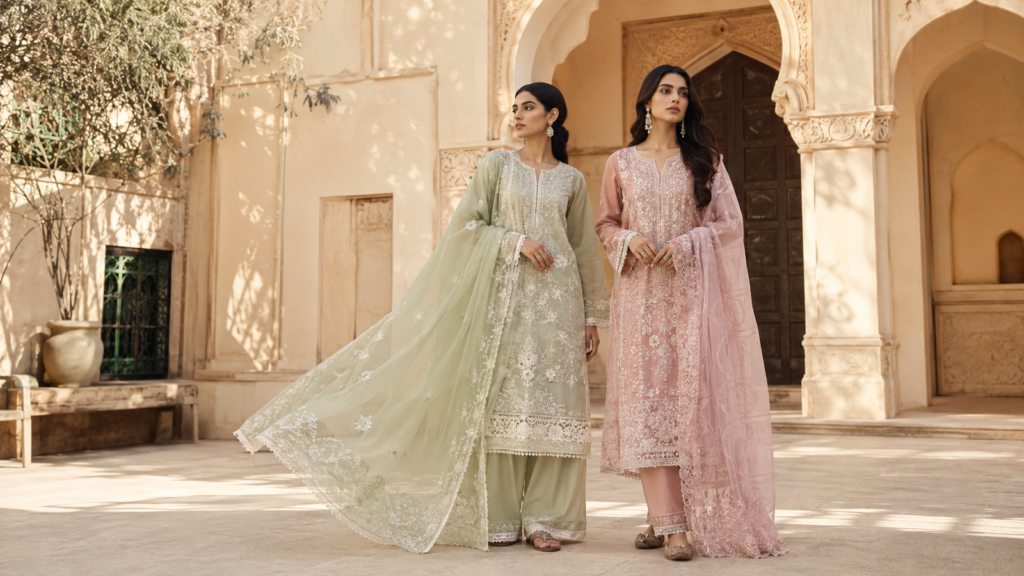
A drawer arranged only by colour can still make choosing a dupatta difficult. Two cream pieces may have different lengths, borders and levels of detail, and each may complete a different outfit. Organise around those relationships as well as the colour you see first.
Start with the dupattas you use most. Leave sentimental or rarely worn pieces for a separate review so the everyday task stays manageable.
Connect each dupatta to real outfits
Choose a dupatta and place it beside the shirts and trousers you would actually wear with it. Test the arrangement if the proportions are uncertain. Record the successful combinations using the garment names you recognise.
Avoid assigning every neutral piece to every outfit. The border scale, length and way you prefer to carry it can make one pairing more useful than another.
Give the piece a simple identity
A label such as “sage plain, lunch suits” or “rose border, evening cream set” can be enough. Use a photograph if several pieces look similar in storage. The label belongs to your organisation system; do not attach anything that could damage the fabric.
Keep any removable matching accessory separately labelled and connected to the same outfit record. A loose decorative piece is easier to locate when it has a clear owner.
Separate ready pieces from action needed
Mark dupattas that need care, a finishing assessment or a repair question. Follow the supplied instructions rather than treating everything in the same drawer alike. Keep an unresolved item from being mistaken for an outfit component ready for tomorrow.
For example, if the border on a favourite dupatta needs attention, note which two suits depend on it. That makes the practical effect visible and may help prioritise the work.
Use a pairing example
Imagine you own a patterned dupatta that works with a plain navy shirt and an ivory kurta, but feels busy beside your floral suit. Store its note with those two successful combinations rather than under a broad label such as “multicolour.”
If you later shop for another piece, the record shows what you already have covered. You may need a quieter finish for the floral suit instead of a second patterned dupatta serving the same two outfits.
Choose storage for the actual construction
Use the garment’s guidance and its shape and decoration to decide how to store it. Avoid forcing all dupattas into identical tight bundles merely for a uniform-looking drawer. If a piece has substantial embellishment or unclear instructions, ask for suitable handling advice.
- Keep the identifying note easy to find.
- Make the most-used pieces accessible.
- Separate pieces awaiting attention from those ready to wear.
- Review pairings when your shirts or preferences change.
The system should reduce searching without making you maintain a complicated inventory. If you can identify the dupatta, find the outfit it completes and know whether it is ready, it is doing its job.
For the next step, read buying a separate dupatta for an existing suit and organising removable outfit details.
Browse the women’s essentials collection for an uncovered pairing rather than another version of a piece you already use.
Continue exploring Wardrobe Planning or browse the Feyorawears Style Journal.
Featured image: Feyorawears editorial illustration.