
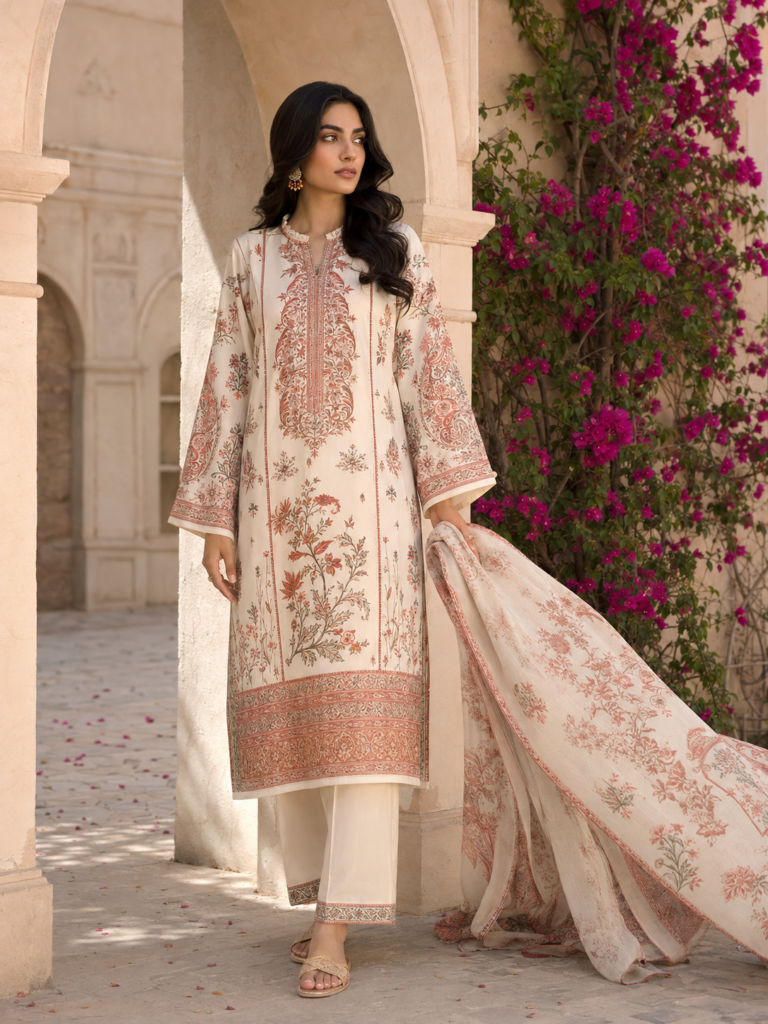
Embroidery deserves a view from both sides. The front tells you about the visible arrangement; the reverse can raise different questions about backing, loose ends, lining and contact with the skin. Before buying, separate the design you admire from the construction details you still need to understand.
You do not need to identify every embroidery technique to make a useful enquiry. You need clear views of the relevant areas and an accurate description of the item being sold.
Map the placement first
List where the embroidery appears: neckline, chest, sleeves, hem, trousers or dupatta. Ask whether it is worked directly onto the garment, supplied as a separate panel, or attached as a trim. These formats can involve different decisions when an unstitched outfit is cut or a finished garment is shortened.
For a shirt with a large central motif, ask for a straight front view and the position relative to the neckline. A posed image can hide how the design sits when the garment hangs naturally.
Request the reverse view that answers your concern
If your concern is comfort at the neckline, a photograph of the back of the hem is not enough. Ask to see the inside of the specific area that will touch you. Confirm whether it is covered by a lining and whether that lining is attached or separate.
Do not remove backing or trim threads to investigate a delivered item. Their role may not be obvious. Ask the seller to identify the material and explain whether anything remains to be finished before wear.
- Is the embroidery already attached to the garment?
- Is any backing intended to remain in place?
- Which embroidered areas are covered by a lining?
- Are decorative pieces supplied loose for later attachment?
- Does shortening affect the motif or its border?
Work through a neckline example
Suppose you like a shirt with a dense embroidered neckline but usually dislike textured surfaces against your upper chest. Request an interior close-up and ask how much of the neckline is lined. If there is a separate slip, establish its neckline depth rather than assuming it covers the embroidered area.
If the slip finishes lower, the embroidery may still contact you in the area you wanted covered. Your decision is then about that actual arrangement, not whether embroidery in general is comfortable or uncomfortable.
Check consistency without demanding identical hand-drawn shapes
Look for unexpected detachment, missing sections or a placement that conflicts with the description. At the same time, distinguish an intentional irregular design from an unexplained fault. Ask before interpreting.
A technique label alone cannot establish how much work went into an item, how it will feel or how long it will last. Keep photographs and written answers together so you can compare the delivered garment with the agreed specification.
The strongest buying decision is specific: you know where the work sits, what is underneath it and what finishing remains. That is more useful than choosing only by the amount of embroidery visible from a distance.
For the next step, read accurate descriptions of handwork and machine embroidery and lining and opacity questions.
Compare pieces in the luxury pret collection by the placement and construction details you can verify.
Continue exploring Quality & Buying or browse the Feyorawears Style Journal.
Featured image: Feyorawears editorial illustration.