
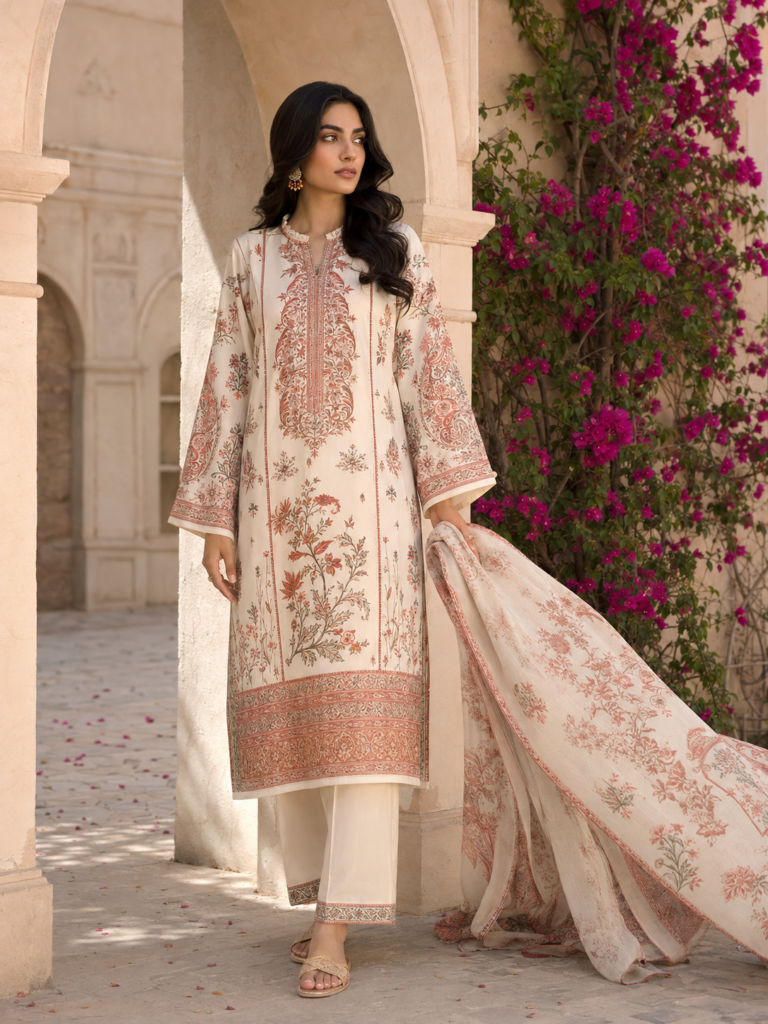
A working-week outfit plan is more useful when it starts with combinations you can repeat easily. If a printed Dhanak-labelled suit has caught your eye, consider how its pattern and components would fit the clothes you already use. The objective is not to buy a separate look for every day. It is to understand which new combinations the purchase would make possible and whether you actually want to wear them.
Begin with three real workdays
Choose three days that represent your routine: perhaps a regular office day, a meeting and a day with plans afterwards. List the practical differences between them. You might want a particular layer for the journey or a less elaborate accessory arrangement when carrying several items.
Now identify the trousers, shoes and dupattas you already reach for on those days. These are your reference pieces. A new print should be compared with them rather than with a collection of accessories you do not own.
Read the print as a layout
Look beyond its colours. Is the pattern repeated evenly, placed in panels or concentrated near the borders? For an unstitched suit, ask which sections are supplied and show the layout to your tailor before committing to a different shirt shape.
A small repeated motif and a large border create different planning questions. The first may leave you more interested in the overall silhouette; the second may make border position central to your choice. Neither arrangement needs to be described as universally more suitable for work.
Build a small combination map
Imagine one printed shirt with a matching trouser option. Your first combination uses the set as supplied. Your second uses the shirt with a plain bottom already in your wardrobe. Your third keeps the matching trousers and changes the dupatta or outer layer.
Write down the exact pieces for each version. If a proposed combination requires several additional purchases, mark it as a future idea rather than counting it as an outfit you can wear immediately. This keeps the plan honest and the budget understandable.
Check the practical details once
Confirm the exact material information, care instructions and the components included. Dhanak as a label does not answer all those questions. If you plan to separate the pieces often, assess each against its intended partner rather than assuming a coordinated set will work with everything.
Our printed-shirt and dupatta guide helps with colour and pattern decisions. Use the capsule wardrobe guide for the broader task of identifying gaps, without repeating the same buying exercise for each workday.
Browse unstitched sets with your three combinations written down. A printed purchase becomes easier to justify when you can point to the specific outfits it adds and the ordinary days on which you expect to use them.
Continue exploring Dhanak & Winter Fabrics or browse the Feyorawears Style Journal.
Featured image: Feyorawears editorial illustration.