
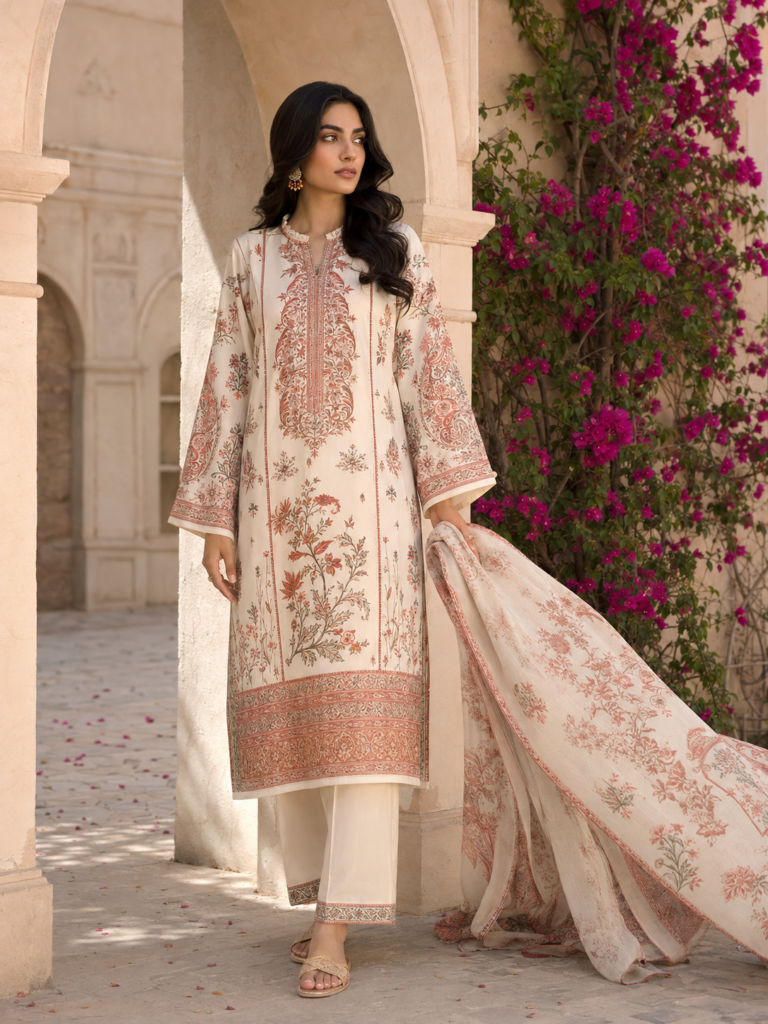
An indoor winter gathering involves more than the journey from your door to the venue. You may spend most of the occasion seated, remove an outer layer after arriving and carry a bag while greeting people. Plan the suit around those moments. A Dhanak or winter label is a starting point for shopping, not a complete answer about how a particular outfit will feel or function in the setting.
Ask about the occasion before choosing detail
Clarify whether the gathering is mostly seated, whether you will move between indoor and outdoor areas, and how formal the host expects the occasion to be. Use the actual invitation and setting rather than assuming every winter event needs the same style.
Choose one part of the outfit to lead visually. It might be a neckline, a shawl border or a print. That choice helps you avoid building a look whose key detail disappears as soon as you sit down or remove a layer.
Plan the outfit underneath the outer layer
Lay out the shirt, trousers and dupatta as a complete combination first. Add the coat or shawl afterwards. If the inner outfit feels unfinished without the extra layer, decide whether you intend to keep that layer on throughout the event.
For example, a decorated shawl may look attractive during arrival but need somewhere to rest during a meal. You could make the shirt neckline the lasting focal point and treat the shawl as an additional detail, rather than depending on it for the entire appearance.
Rehearse seated use
Try the outfit or a similar silhouette with your planned footwear. Sit at a table, reach forwards and stand again. Notice where the shirt hem, cuffs and dupatta ends fall. Assess your preferred coverage without pulling everything into place only for the mirror.
If the suit is unstitched, explain those preferences to your tailor before the shape is fixed. A photograph of a familiar seated outfit can support the conversation, provided you describe what you like about it rather than asking for a vague imitation.
Confirm the specific garment information
Read the material details for each component and ask about missing information. Keep care and handling questions tied to the actual item. Do not assume a seasonal collection name establishes fibre percentages, a suitable room temperature or an identical experience across different designs.
The shawl-suit component checklist is useful for a multi-piece purchase. If you plan both a dupatta and an extra layer, see how to organise that pairing.
Browse unstitched outfits once you have described the occasion in practical terms. Choose the design whose visible details and planned arrangement make sense during the gathering itself, not only in the arrival photograph. That approach leaves space for personal style while making the outfit easier to enjoy.
Continue exploring Dhanak & Winter Fabrics or browse the Feyorawears Style Journal.
Featured image: Feyorawears editorial illustration.