
Dhanak and karandi are names you may encounter while searching for a winter outfit, but the names alone do not provide a fair comparison. Two sellers can supply different levels of detail, and two suits can have very different constructions even when their photographs suggest similar shapes. Treat the choice as a comparison of specific products, with a separate space for what remains uncertain.
Begin with the composition field
Read the material statement for each component rather than relying only on the main title. ISTOR’s Classic Karandi page names silk and cotton in its composition field without percentages. That is a seller disclosure for one item, not a universal definition of karandi. A Dhanak-labelled alternative needs its own specification rather than a guessed equivalent.
If the description mixes fabric names and fibres, ask the seller to clarify which information is documented. Keep the original wording with the reply. This prevents a shortened note from becoming more definite than the evidence that produced it.
Ask texture questions that photographs can answer
Request an open view and a close-up at a similar scale for both candidates. You can compare visible surface detail, motif placement and the appearance of the edges. You cannot establish fibre percentages or long-term performance simply by looking at the images.
Describe what you are deciding: perhaps you want a surface that does not compete with an embroidered neckline. This makes the request more useful than asking which fabric is better. Your preferred appearance is a legitimate part of the choice, as long as it remains a preference.
Compare the proposed shape
Imagine one suit shown as a straight shirt and the other as a more open silhouette. Decide which shape you actually want before comparing the photographs. A difference caused by styling or cut should not automatically be attributed to the fabric label.
If both are unstitched, show the proposed design to your tailor and ask whether the supplied panels and quantities support it. Keep the response specific to those pieces. Avoid assuming that one trade name guarantees the same cutting possibilities as another.
Make the final note explicit
- What composition information has been supplied?
- Which visible surface do you prefer beside the decoration?
- Does the intended cut work with the supplied components?
- What additional materials or preparation are required?
- Which unanswered point could change your decision?
For a closer look at karandi descriptions, read karandi buying notes. If your main uncertainty concerns the word Dhanak, use the listing interpretation guide.
If a supplier offers a substitute, ask for its own details rather than treating the original specification as transferable.
Explore unstitched clothing with your intended silhouette and specification questions ready. This approach allows a confident personal choice while keeping the limits of the available fabric information clear.
Continue exploring Dhanak & Winter Fabrics or browse the Feyorawears Style Journal.
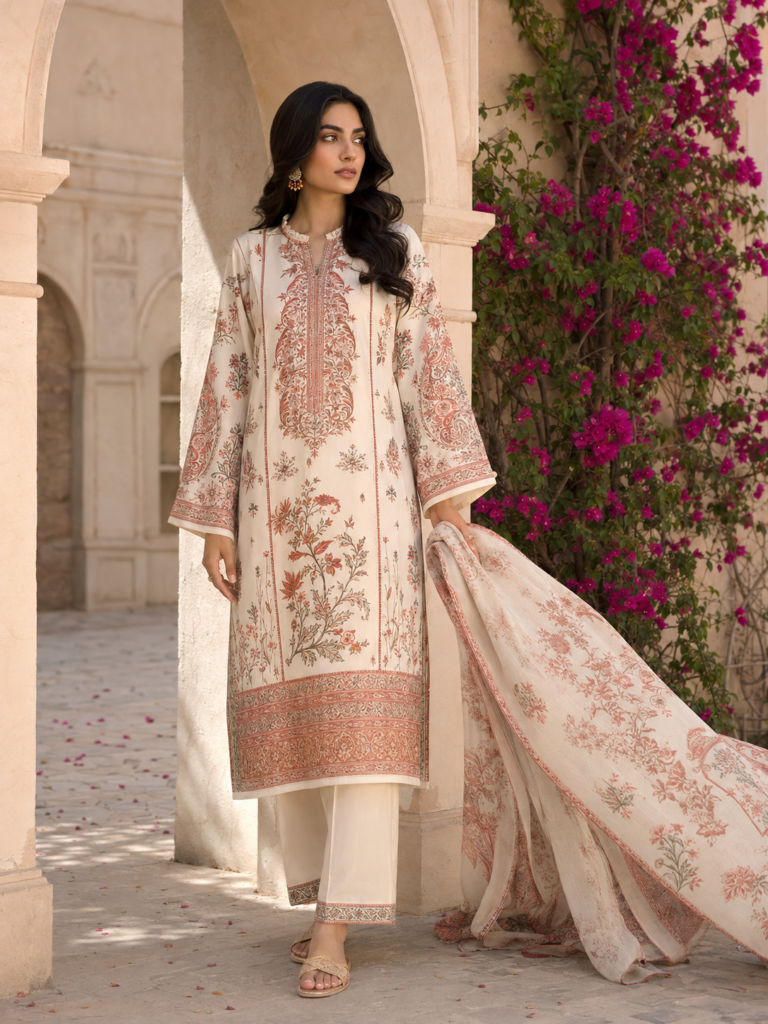
Featured image: Feyorawears editorial illustration.